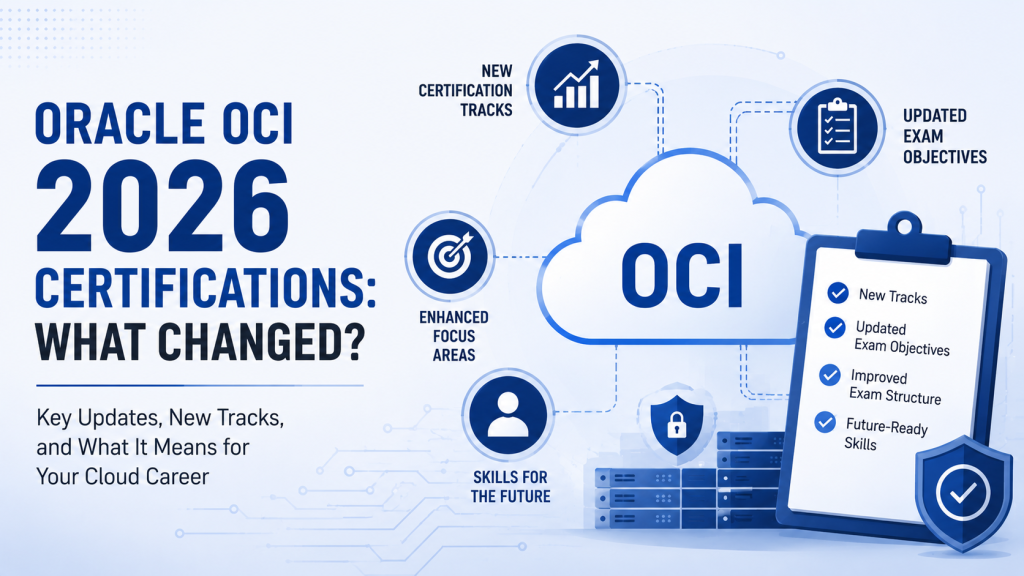
If you started studying for Oracle’s OCI Foundations Associate exam sometime in the past year, there’s a real chance the version you were using no longer exists. Oracle retired the 2025 editions of its three free Oracle Cloud Infrastructure certifications on June 22, 2026, and quietly replaced them with 2026 versions. There was no press release and no big announcement. The change simply appeared on Oracle University’s site, and plenty of study guides and practice test vendors still haven’t caught up with it, including some prep material still being sold for the retired 2025 exam codes.
Here’s what actually changed, what the new 2026 exams cover, and whether Oracle’s free certification path is still worth your time.
Oracle Quietly Retired Three Free Certifications in June 2026
Oracle offers three certifications at its Foundations level, and all three are built around the same idea: a completely free, entry-point credential that doesn’t require hands-on OCI experience. The 2025 versions of all three retired on June 22, 2026:
- OCI 2025 Foundations Associate (1Z0-1085-25), the general-purpose cloud fundamentals exam
- OCI 2025 AI Foundations Associate (1Z0-1122-25), covering AI and machine learning on OCI
- OCI 2025 Data Platform Foundations Associate (1Z0-1195-25), covering Oracle’s database and data platform services
None of this affects anyone who already passed one of these exams. A certification you’ve already earned stays on your Oracle University transcript permanently, the same way it does when Microsoft retires an exam track or when Cisco reshuffles its CCNA curriculum. What changes is the path forward: if you were mid-study on any of the three retired exams, you’re now preparing for a test that no longer exists, and you need to switch to its 2026 replacement.
Meet the Three Free OCI Certifications for 2026
The three replacements, 1Z0-1085-26, 1Z0-1122-26, and 1Z0-1195-26, keep the same free, voucher-based model and roughly the same exam format as their predecessors. Here’s how they compare at a glance.
| Certification | Exam Code | Format | Best For |
|---|---|---|---|
| OCI 2026 Foundations Associate | 1Z0-1085-26 | 40 questions, 60 minutes, 65% to pass | General cloud fundamentals, sales, procurement |
| OCI 2026 AI Foundations Associate | 1Z0-1122-26 | 40 questions, 60 minutes, 65% to pass | AI/ML fundamentals, no coding required |
| OCI 2026 Data Platform Foundations Associate | 1Z0-1195-26 | 40 questions, 60 minutes, 65% to pass | DBAs and data engineers moving to OCI |
OCI 2026 Foundations Associate (1Z0-1085-26)
This is Oracle’s generalist entry point, and it’s the one most people mean when they say “OCI certification.” The exam spreads across OCI’s distributed cloud model, regions and availability domains, core compute, networking and storage, identity and access management, and governance topics like tagging, compartments, and cost control. It assumes no prior cloud experience, which is why Oracle markets it as much to sales and procurement staff as to engineers. If you’re deciding where to start with Oracle Cloud at all, this is the exam, not the AI or data platform variant.
OCI 2026 AI Foundations Associate (1Z0-1122-26)
This one carries real weight for anyone tracking where cloud hiring is actually headed. The domains cover AI fundamentals, machine learning, deep learning, generative AI and large language models, the OCI AI portfolio, and OCI’s broader AI services, with generative AI and LLMs alone accounting for roughly a quarter of the exam. It requires no coding background and no prior AI or ML exposure. Given how much of Oracle’s own cloud investment is now aimed at AI infrastructure, this exam functions as a low-cost way to show you understand where that investment is going, similar to how Nvidia’s AI infrastructure certification has become a credential recruiters specifically search for.
OCI 2026 Data Platform Foundations Associate (1Z0-1195-26)
This exam is the least generic of the three. It covers Autonomous Database, Exadata and Database Cloud Service, MySQL and NoSQL on OCI, Oracle’s converged database model, data resiliency, application development against Oracle Database, and Oracle’s data lake, data warehouse, and machine learning services. It’s aimed squarely at DBAs, data engineers, and anyone supporting an existing Oracle Database estate that’s being pushed toward OCI, rather than at generalists.
Why Oracle Gives Away Certifications Its Rivals Charge For
AWS charges roughly $100 for its Cloud Practitioner exam. Microsoft charges about the same for Azure Fundamentals. Google’s Cloud Digital Leader carries a similar fee. Oracle is the outlier: all three of its Foundations-level exams ship free, with free training bundled in, while its Associate, Professional, and Expert-level exams carry a standard $245 fee.
That’s not generosity for its own sake. Oracle Cloud Infrastructure still trails badly on raw market share, sitting around 3% of global cloud infrastructure spend as of mid-2025 while AWS, Microsoft, and Google split roughly two-thirds of the market between them, according to Synergy Research Group’s cloud market tracking. Free certifications are a cheap way to build a base of people who know OCI well enough to recommend it, especially now that AI infrastructure has become the fastest-growing slice of cloud spending, up from 8% of total cloud spend in 2023 to 19% in 2026 by Synergy’s count. Oracle would rather have thousands of people casually AI-Foundations-certified than protect $245 per exam attempt. Other vendors are reshaping their own certification lineups for entirely different reasons right now too, like Juniper’s exam catalog shifting after HPE’s acquisition, which is a reminder that no certification roadmap stays fixed for long in this industry.
What the Job Market Actually Pays for OCI Skills
A Foundations-level certification alone won’t move your salary much. It’s a screening credential, not a specialist one. But it’s worth knowing what the tier above it actually pays, since that’s the realistic destination if you take OCI seriously.
- OCI Architect roles average $71.84 an hour in the US, with most postings falling between $59.38 and $81.97 an hour, according to ZipRecruiter’s July 2026 wage data
- Cloud Architect roles at Oracle itself average around $200,000 a year, with reported pay clustering between roughly $157,000 and $258,000 depending on level
- Cloud Solution Architect roles at Oracle average closer to $234,000 a year, with top-end reported pay reaching into the high $300,000s
None of that is guaranteed by passing a free 40-question exam. What the Foundations certifications actually do is get your resume past a keyword filter and give you enough shared vocabulary to hold a real conversation about OCI in an interview. The salary numbers above belong to people who built real, hands-on OCI experience on top of that starting point.
How to Actually Claim the Free 2026 Exam Vouchers
Oracle’s free model isn’t automatic. You don’t just book the exam for $0. The free voucher is tied to completing a specific learning path, and skipping that step means paying Oracle’s standard exam fee out of pocket. The process works like this:
- Create or sign in to an Oracle University account through Oracle’s learning platform
- Enroll in the matching 2026 learning path, such as “Become an OCI 2026 Foundations Associate”
- Complete the required training modules and any embedded knowledge checks
- Claim the free exam voucher that unlocks once the learning path is finished
- Schedule the proctored exam through Oracle’s exam system and sit the 60-minute test online
Results come back immediately after you submit, and Oracle typically issues the digital badge and certificate within a few business days. If you skip straight to booking the exam without finishing the learning path first, expect to be charged.
Who Should Start With the Free Track, and Who Should Skip It
These exams are genuinely useful for some people and a waste of a weekend for others. Worth starting if you fall into one of these groups:
- You’re new to cloud entirely and want a low-stakes way to learn OCI’s vocabulary before committing money to a paid exam
- You work in sales, procurement, or partner management for a company that resells or implements Oracle Cloud
- You’re a DBA on Oracle Database who needs to speak credibly about where Oracle’s data platform is headed on OCI
- You want a free, low-risk way to test whether OCI’s AI services are relevant to a role you’re targeting
Skip it, or at least don’t stop there, if any of this sounds like you:
- You already hold an AWS, Azure, or GCP associate-level certification and understand cloud fundamentals generally
- You need a credential that proves hands-on OCI skills for a job application closing soon, since Foundations-level exams test recall, not practical ability
- You’re targeting a specialist AI engineering role, where employers are looking for something closer to a professional-level credential
What Comes After the Foundations Track
Foundations-level certifications feed into Oracle’s paid Associate and Professional tiers, each carrying the standard $245 exam fee. The most relevant next steps depend on which Foundations exam you started with: OCI Architect Associate and Professional for the general track, and Oracle Cloud Infrastructure Generative AI Professional for anyone who found the AI Foundations material genuinely interesting rather than just easy.
This layered structure, free entry point followed by paid specialist tiers, isn’t unique to Oracle. Cisco runs the same logic between CCNA and CCIE, just with tuition attached at every step. Red Hat did something similar when it restructured its RHCSA-to-RHCA track earlier in 2026. If you want to browse what else DirectCertify carries across Oracle’s full certification catalog, from database administration to WebLogic, the Oracle certification section covers the exams beyond the three discussed here.
One honest note before the FAQ: DirectCertify is an independent certification prep provider. We’re not Oracle Corporation, and nothing on this page is written, reviewed, or endorsed by Oracle. Exam codes, pricing, and voucher policies change on Oracle’s own schedule, not ours, so confirm current details on Oracle’s own certification pages before you register for anything.